Japandi kitchen ideas — see them on your own kitchen
Browse the style below, then preview it on a photo of your actual kitchen — structure untouched.
Preview this style free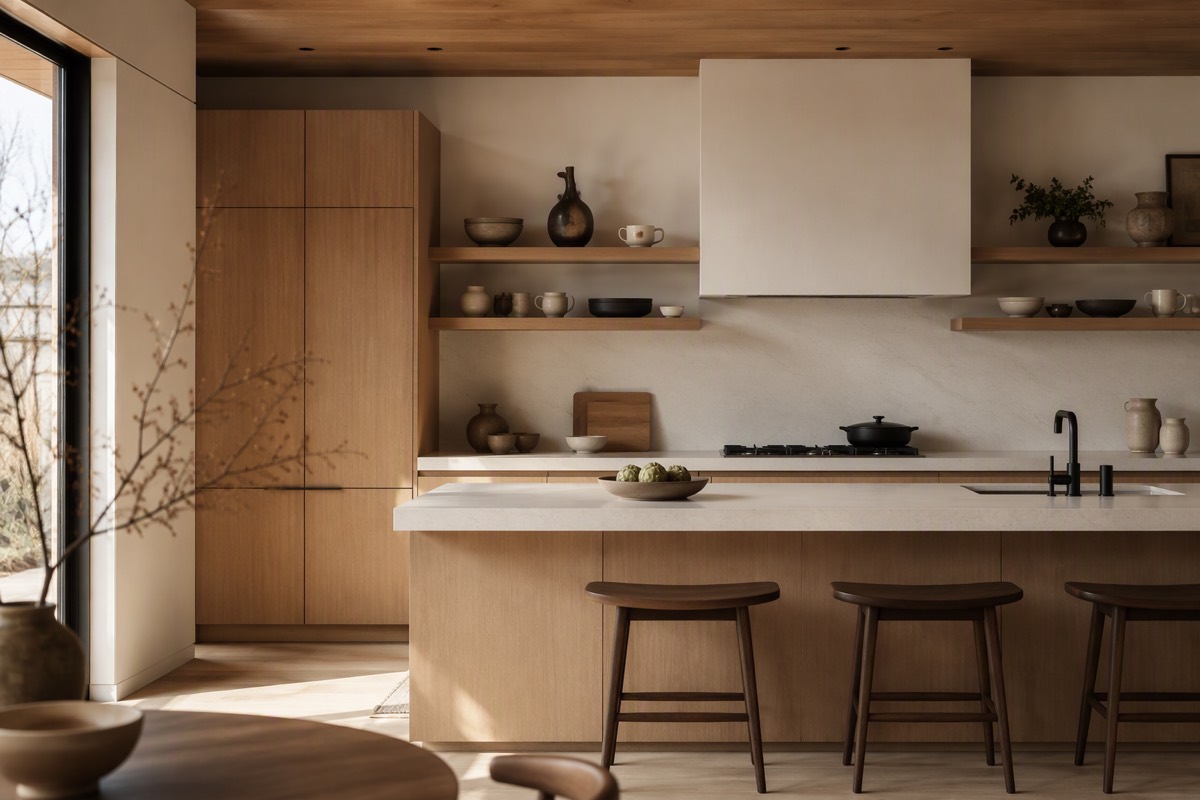
A Japandi kitchen strips the busiest room in the house down to calm function: flat-front cabinetry, a restrained material palette, and almost nothing on the counters. The cabinet strategy is the foundation — handleless flat panels in light oak, walnut, or a muted matte color like sage or warm grey. Wood tone is the personality, so pick one species and repeat it; mixing oak uppers with walnut lowers fragments the calm. Countertops stay quiet: pale quartz, honed stone, or light butcher block — high-contrast veining fights the mood. The backsplash is an opportunity for texture rather than pattern: handmade-look zellige in off-white or a simple vertical stack of matte tile. Open shelving appears once, as a single run of light wood holding ceramics and glasses with space between them; if your household produces clutter, skip it entirely — Japandi survives on closed storage. Hardware, if used at all, is minimal: small black or brass knobs, never statement pulls. Lighting should be warm and low-profile: a paper or rattan pendant over the eating spot, under-cabinet strips rather than showy fixtures. The color ceiling is three tones: warm neutral walls, one wood, one dark or green accent. The mistakes: waterfall islands in high-drama stone (too loud for the style), and stainless-everything appliances on display — panel-ready or compact matte black appliances keep the elevations calm. Functionally, this style rewards the decant-and-conceal household: counters hold a kettle, a board, maybe one ceramic vase with a branch — everything else lives behind doors. Because Japandi depends on the exact relationship between your wood tone and your wall color, and that relationship changes completely under your kitchen's light, preview the pairing on your actual room before ordering cabinet fronts — render two wood tones against your walls and the right one stops being a guess. The result should feel like the kitchen exhaled.
Five moves that make it work
- 1Handleless flat-panel fronts; one wood species throughout
- 2Quiet counters — pale quartz or honed stone, no drama veining
- 3One run of open shelving maximum, or none
- 4Warm low-profile lighting: paper pendant, under-cabinet strips
- 5Counters hold three objects, everything else conceals
Questions, answered
- Is Japandi practical for a working family kitchen?
- Yes if you commit to closed storage — the style is mostly a storage philosophy. Without concealed space for the daily clutter, it collapses.
- What cabinet color if not wood?
- A muted matte sage, warm grey, or off-white — flat finish, no gloss, minimal hardware.
- Can I compare wood tones on my actual cabinets?
- Yes — upload a photo and Vizahome renders oak, walnut, or painted fronts on your real layout and light.
Don't guess — preview japandi on your real kitchen.
Try it free3 free designs. No credit card required.